Why you are kicking people off your social media page who don’t agree with you. 

People seek only the information that validates their existing beliefs which tends to make them believe it more whether right or wrong. 

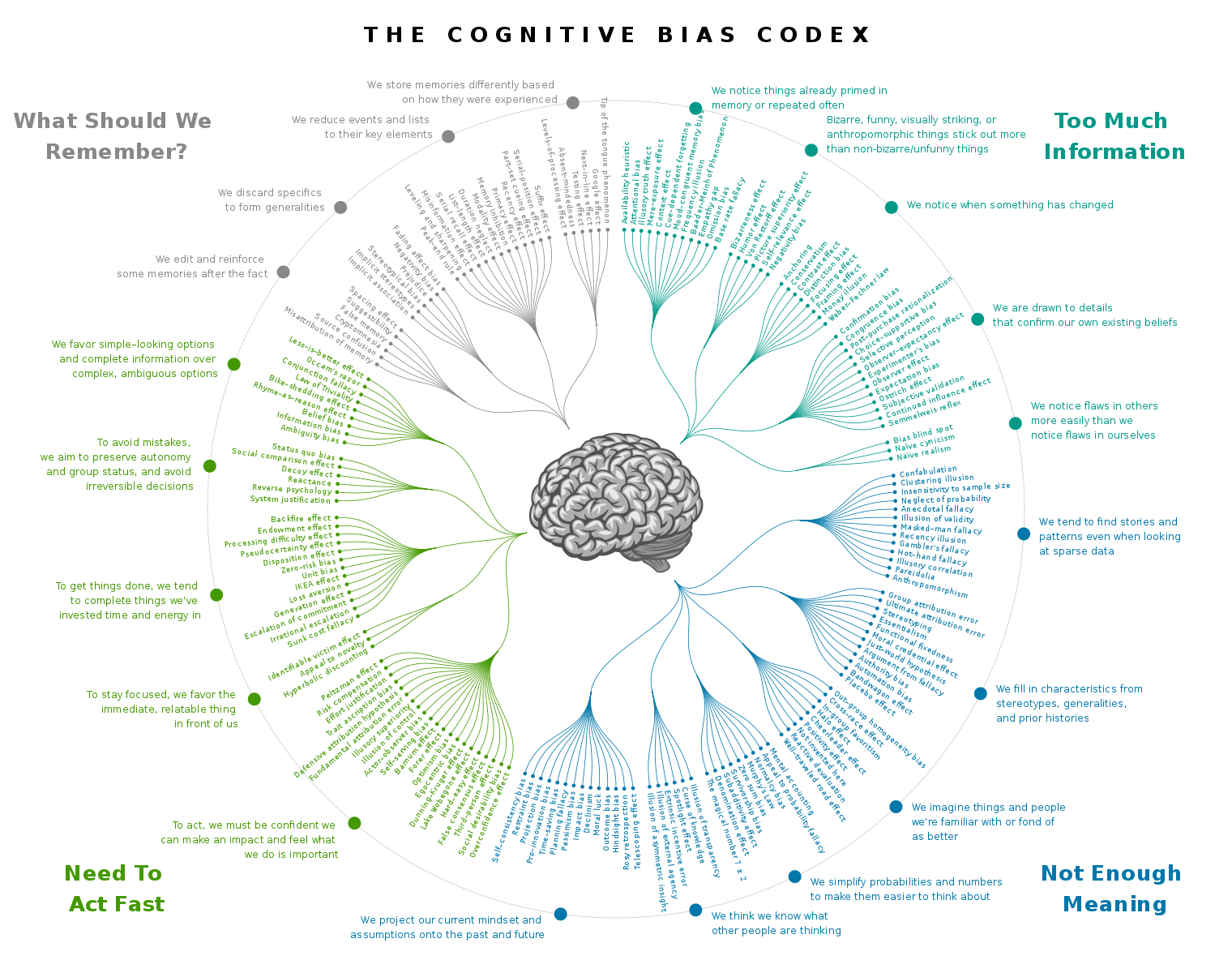
As a designer, I study people – the way they think, act,  perceive, learn, memorize, etc. Part of these human factors are cognitive biases. Confirmation bias is a type of cognitive bias that favors information that confirms previously existing beliefs or biases. 

People seek only the information that validates their existing beliefs which tends to make them believe it more whether right or wrong.  
Here are some ideas to avoid confirmation bias.  


Understand your tendency to exclude other opinions and facts and seek information that only validates your existing beliefs. Think For yourself. Do your own research. Question what you hear and see. Don’t just follow the crowd belief.Validate information with what you personally hear and observe. Sincerely listen to an opposing view without feeling your ego is being attacked and defending your stance. Seek information outside your normal comfort zone. Check all facts before jumping to conclusions. Challenge assumptions. Don’t read this and assume it doesn’t apply to you.

What are the least effective ways to eliminate confirmation bias?

Kick everyone off your social media page that doesn’t support your view. Name call and attack people with different points of view.Demean or stop talking to others that don’t agree with you. Surround yourself only with information and people that confirm your beliefs. Profile people into wide groups with sweeping generalizations – if you believe this then you also do x, y and z.


What ways can the government help with confirmation bias in government services?

Verifiable Data

Transparency

Accountability


Empathy – Understanding people’s unique challenges, emotions, culture, and goals allow for empathy. Empathy creates compassion which is necessary for shifts in mindset. Shifts in mindset change the world.

In the end, we will remember most the actions, character and behaviors of our family, friends and neighbors and the character traits they exhibited during this unprecedented time.

Our vision is a country where people have equal access to public services because they are designed in a way that is thoughtful, intuitive, easy to navigate, transparent, accountable and user-centered. 

The Top UX “Sins” Made by Beginner Designers.

  • Taking every bit of customer feedback and implementing it. 
  • Design by committee.
  • Listening to only what users say, not observing what they actually do. 
  • Not starting with a problem statement or reframing the problem. 
  • Going with the first decent idea.
  • Not understanding human factors – the way people think, make decisions, behave, perceive, cognitive biases, etc. 
  • Not using a hierarchy of information. 
  • Not asking the right questions.
  • Not talking to the right users. 
  • Not talking to any users. 
  • Leading users in design research with your own agenda.
  • Being biased.
  • Letting the stakeholders vote on the design (design by committee).

How to Communicate With Your Customers During Times of Crisis

Emotions are important in design because they are a powerful motivator and can influence perception, cognition, attention, decision-making, learning, memory and behavior. If we can learn how to evoke, predict or assess a specific emotion in design, we can better present information in a way that aids in understanding and retaining information and communicate more effectively.

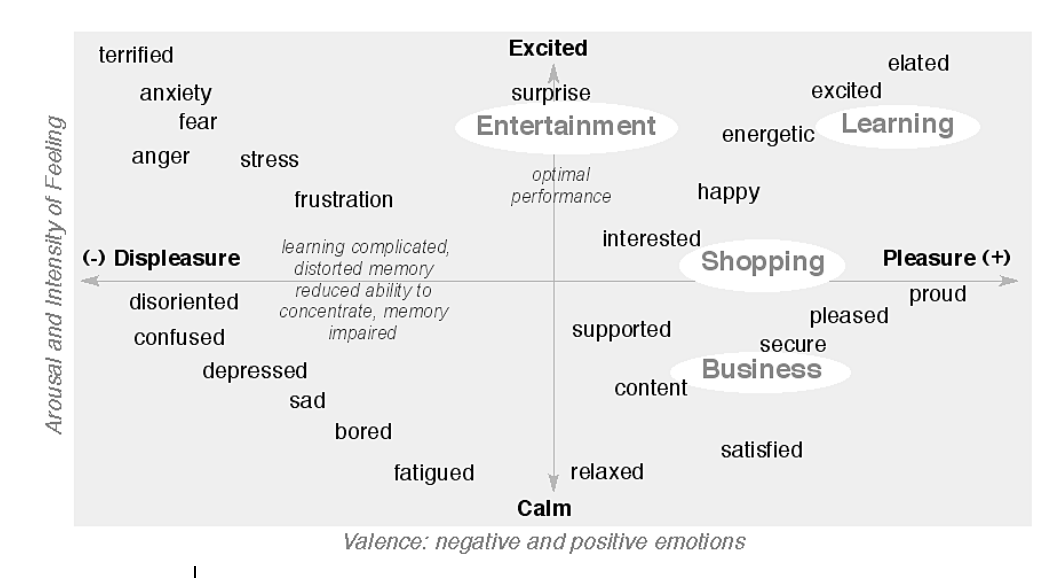
Extreme states of emotions such as anxiety, fear and anger can complicate learning because they interfere with sensory perception.  Sensory systems allow us to make sense of ourselves and our surroundings and if distorted can cause the emotional organization of our experience to be compromised.  As a result, learning can be detrimentally affected. Under stress users can develop tunnel vision and auditory exclusion. For example, they wouldn’t hear an alarm going on while trying to complete a task.

When a person is highly aroused, as in a very shocking or surprising situation, they are more likely to form a memory of the event and possibly a distorted memory.  Arousal (excited/calm) has been found to be a better predictor of memory retention than valence (pleasure/displeasure).  However, strongly negative things tend to automatically be highly arousing, leading many to think that better memory is correlated with negativity.  If we are depressed, anxious or tired, we are more likely to have difficulty remembering.  When we are upset or distracted, we cannot concentrate as well which impairs our memory. Too much stress results in poor performance. 

To help communicate with your customers during periods of stress, fear, or anxiety several design principles are critical. 

Use bite-size chunks of information

Users can only consciously process small amounts of information at a time. Grouping and chunking information aids in memory retention.

Consistency and standards
Users should not have to wonder whether different words, situations, or actions mean the same thing. Be consistent. 

Error prevention

 Even better than good error messages is a careful design which prevents a problem from occurring in the first place.

Recognition rather than recall

 Make objects, actions, and options visible. The user should not have to remember information from one part of the dialogue to another. Instructions for use of the system should be visible or easily retrievable whenever appropriate.

Aesthetic and Minimalist Design

 Dialogues should not contain information which is irrelevant or rarely needed. Every extra unit of information in a dialogue competes with the relevant units of information and diminishes their relative visibility. 

Anticipation

 Anticipate the user’s wants and needs. Bring to the user all the information and tools needed for each step of the process.

Inconsistency
It is just important to be visually inconsistent when things must act differently as it when things act the same.

Good design is design thinking made invisible. Now more than ever, it’s important to understand and empathize with your customers, make doing business with you easy and intuitive, and provide clear communication.

Partner with a frog, cast a love spell on your customers, leap over your competition and live happily ever after.

Frogs are symbols of joy, luck, money, prosperity, abundance, wealth, and friendship in many cultures. Used as an amulet and talisman, they are strongly linked with transformation and magic and are believed to bring good luck. They are the magic in fairy tales and the secret ingredient in magic spells.

Why we chose the name Pink Frog Interactive.

Pink

Pink is the color of happiness. Pink Frog brings joy to our clients and their customers. Joy is evoked in design with micro-interactions and an understanding of your users. Repeated strikes of an emotion cause it’s perceived intensity to increase. Happiness turns into joy after repeated positive interactions. Users remember the peak and endpoint of any experience. We focus on understanding your users’ emotions and finding out what constitutes exceptional customer experience. Happy users are more trusting and loyal.

Frog

Frogs are symbols of joy, luck, money, prosperity, abundance, wealth, and friendship in many cultures. Used as an amulet and talisman, they are strongly linked with transformation and magic and are believed to bring good luck. They are the magic in fairy tales and the secret ingredient in magic spells. The three-legged money frog, wealth frog, and lucky frog are three of the five Chinese gods that offer protection against misfortune and enrich a business or household in wealth. According to ancient Feng Shui beliefs, placing a frog near you dispels evil and attracts wealth.

Frogs are the happily ever after in fairy tales. If you kiss a frog, it turns into a prince. Frogs are the only animal that can only move forward and not backward. They can see in all directions without moving their head. A frog is often the elixir in magic potion.

Interactive

Interactive because we improve interactions at each touchpoint in your customers’ journey. We help you leap over your competition. We interact with you, your customers and your stakeholders to help you:

  • Tame complexity of your products or services.
  • Deliver innovative products and services that your customers love.
  • Decrease customer support calls.
  • Communicate complex information.
  • Help your customers intuitively navigate your product and services.
  • Help you understand how your customers learn and make decisions.
  • Help you understand how your customers define what constitutes an exceptional customer service.
  • Raise customer satisfaction scores.
  • Raise net promoter scores.
  • Gain more trust and loyalty from your customers.
  • Raise stock prices – companies that invest in design outperform 2 to 1. The key differentiator in companies is a positive customer experience. Customers choice products and services that are easy and joyful to use.

Behold! The power of design.

How Pink Frog Interactive saved one customer $$$ millions of dollars by fixing one link.

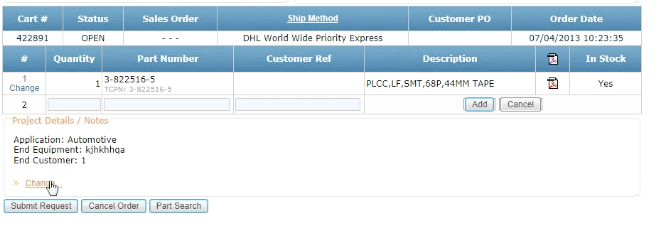
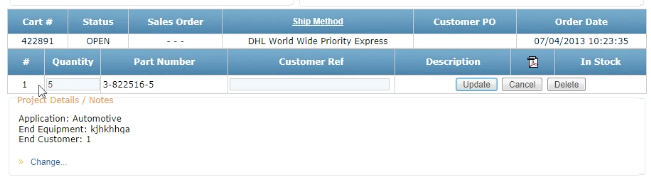
Pink Frog Interactive was hired to map out customer touchpoints (on and offline) for larger and smaller customer accounts around the globe as part of an exceptional customer experience project for a 14 billion-dollar company. While interviewing the customers about their touchpoints with our client and their decision-making points, we found that all three user groups around the globe did not believe that they could order as many samples as they needed to prototype the product. The engineers believed they could only get one sample and would often call managers and distributors to try to get more. The managers and distributors, using the same poorly designed interface, also believed they could only order one sample. In addition, finding mating and tooling for the sample part was difficult due to poor search futures, interface content, and nomenclature.

Ordering samples was a key decision making touchpoint for engineers. In fact, it was the most critical. Once engineers ordered samples to spec into their product the chance of changing them at a later time was almost nonexistent. While the engineers preferred our client’s products over the competitors and were even willing to pay more for them, they often believed they were forced to go with a competitor because they could easily get as many samples as they needed quickly and easily.

In contrast, their competitors did samples very well. They knew ordering samples and having easy access to mating and tooling parts for the samples where all key decision making points. The competitors had overnight samples on the front of their website and made mating and tooling parts just as easy to access. Once the part was in the prototype, the sale was made.

Let us help you empathize with your customers, understand your customer’s touchpoints, customer journey and decision-making points.