Unlocking Digital Success: The Value of a User Experience Design Agency

In today’s digital economy, your website or application is often the first—and most critical—point of contact with customers. A clunky, confusing, or frustrating interface is more than a minor inconvenience; it’s a direct cause of lost revenue and a damaged brand reputation. This is where a user experience design agency becomes an invaluable partner. These specialized firms go beyond aesthetics, focusing on the entire journey a person takes with your product. Their core mission is to make that journey intuitive, efficient, and enjoyable, ensuring users can achieve their goals with ease.

Partnering with a professional UX design agency unlocks significant benefits, from boosting customer loyalty and conversion rates to accelerating your time-to-market. This article guides Fortune 500 Companies and Enterprises, Healthcare and Life Sciences Organizations, Venture Capital Firms, and Fine Art and Luxury Service Firms business leaders, product managers and marketing professionals through the comprehensive services, strategic advantages, and key factors to consider when choosing the right UI UX design company to drive digital success.

What Services Does a Leading UI/UX Design Company Provide?

A premier UI/UX design company acts as a strategic partner, offering a holistic suite of services that align user needs with business objectives. They do more than “make things look good”; they build a comprehensive framework for a successful digital product. Their services span from deep strategic research to pixel-perfect visual execution, ensuring every decision is informed and purposeful.

The foundation of any project lies in core UX (User Experience) services:

  • User Research: In the discovery phase, a user experience design firm uses methods like in-depth interviews, surveys, persona development, and competitive analysis to understand the motivations, pain points, and behaviors of your target audience. This research forms the bedrock of all subsequent design decisions, eliminating guesswork and grounding the product in real-world user needs.
  • Information Architecture (IA): If a digital product were a building, IA would be its blueprint. Agencies expertly structure and label content to create intuitive navigation. The goal is findability—ensuring users can locate information and complete tasks logically and without confusion. This is especially critical for complex websites and applications.
  • Wireframing & Prototyping: This is where ideas become tangible. Wireframes are low-fidelity blueprints mapping out the structure and layout of each screen. These evolve into high-fidelity, interactive prototypes that simulate the final product’s functionality. This process allows stakeholders to test flows and validate concepts long before any code is written, saving significant time and resources.
  • Usability Testing: Designs are hypotheses until they are tested. A ux agency facilitates sessions where real users interact with a prototype. By observing their behavior, the team can identify friction points, validate design choices, and gather actionable feedback to refine the experience.

Complementing the UX foundation are the core UI (User Interface) services:

  • Visual Design: This is the aesthetic and emotional layer of the product. It involves applying branding, typography, color theory, and imagery to create a visually engaging and cohesive interface that builds trust and delight.
  • Interaction Design (IxD): A user interface design agency focuses on how users interact with the product. It crafts intuitive animations, transitions, and feedback mechanisms (like the satisfying feel of a button click) that make the experience feel smooth and responsive.
  • Design Systems: For scalability and consistency, agencies often create comprehensive design systems. These centralized libraries of reusable components, guidelines, and code snippets allow teams to build new features faster and ensure a consistent brand experience across all digital touchpoints.

Beyond these core services, the best UI UX design company also offers strategic guidance, such as product strategy to help define the roadmap and KPIs, looking at the backend as well as the front end, and accessibility (A11y) consulting to ensure the product is usable by people of all abilities.

Why Partner with a Specialized UX Design Firm?

While some organizations consider building an in-house team, partnering with a specialized UX design firm offers distinct strategic advantages that drive business growth and deliver a significant return on investment. These external experts bring a level of focus, diverse experience, and objectivity that is often difficult to replicate internally.

The most immediate impact is on user satisfaction and loyalty. A professional UX design process is centered on removing friction. When users can accomplish their tasks effortlessly, their frustration plummets and their trust in your brand soars. This positive experience fosters repeat usage and transforms casual users into loyal brand advocates. A seamless journey shows customers you respect their time and value their business, creating a powerful emotional connection that competitors find hard to break.

This enhanced satisfaction translates directly to business growth and ROI. A well-designed user flow guides customers toward key actions, dramatically increasing conversion rates—whether that means completing a purchase, filling out a lead form, or subscribing to a service. Furthermore, partnering with a user experience design company is a model of cost efficiency. By identifying and solving design and usability problems during the prototyping phase, you avoid costly development rework later in the product lifecycle. This “measure twice, cut once” approach, championed by any good ui ux agency, also streamlines the entire process, leading to a faster time-to-market and a quicker path to revenue.

Perhaps the most crucial benefit is gaining access to specialized expertise and fresh perspectives. A dedicated ux design firm lives and breathes user experience. Its teams have encountered a vast array of challenges across different industries, from e-commerce and fintech to SaaS and healthcare. This cross-pollination of ideas allows them to apply innovative solutions to your unique problems. Free from internal biases and company politics, an external agency can provide the objective, user-centric insights needed to challenge assumptions and drive true innovation. They stay current with the latest design trends, research methodologies, and emerging technologies, ensuring your product isn’t just effective today, but prepared for tomorrow.

Choosing the Best UI UX Agency: Key Considerations for Your Project

Selecting the right partner is critical to your project’s success. With many UI UX design firms to choose from, a thorough evaluation is essential to find the best UI UX agency for your specific needs. This decision should be based on a combination of their past work, process, team, expertise, and cultural fit.

First, evaluate the agency’s portfolio and case studies. Look beyond polished final screens. A strong portfolio showcases not just the “what” but also the “why.” Look for projects relevant to your industry or that address similar business challenges. A great case study details the agency’s problem-solving approach: What was the initial problem? What did their user research uncover? How did their design solution address those findings, and most importantly, what was the measurable impact on the client’s business? This demonstrates their ability to deliver results, not just deliverables.

Next, assess the team’s expertise and methodology. Don’t hesitate to ask about the specific individuals who will work on your project. What are their backgrounds and years of experience? It’s also crucial to understand their design process. Do they follow a framework like Agile or Design Thinking? How do they plan to integrate with your internal product, marketing, and development teams? A transparent, collaborative methodology is a hallmark of the best UI UX design agency. Inquire specifically about their approach to user research and usability testing, as this is the core of evidence-based design.

Equally important is communication and cultural fit. This will be a close partnership, so you need to ensure your teams can work together effectively. During initial conversations, evaluate their responsiveness, clarity, and listening skills. Do they ask insightful questions about your business goals and users? A great partner acts as a strategic consultant, not just an order-taker. Discuss their project management tools, meeting cadences, and how they report progress. A strong cultural fit ensures a smoother, more collaborative, and ultimately more successful engagement.

Finally, discuss budget and pricing models and check references. A reputable ui ux company will be transparent about its costs. Understand their pricing structure—whether it’s a fixed price for a well-defined scope, an hourly rate for flexible work, or a monthly retainer for ongoing support. Always ask for client testimonials or, even better, references you can speak with directly. Hearing from past clients will provide invaluable, real-world insight into what it’s like to work with the agency day-to-day.

The Impact of Strategic User Interface Design on Business Outcomes

While UX provides the blueprint, the User Interface (UI) is the tangible, sensory experience that users see and touch. The work of a skilled user interface design agency has a direct and measurable impact on critical business outcomes. Strategic UI is not just about choosing attractive colors and fonts; it’s about crafting an interface that actively drives user engagement, boosts conversions, and strengthens your brand identity.

A compelling UI is a powerful tool for increasing user engagement and retention. Humans are visual creatures, and an aesthetically pleasing, intuitive interface immediately captures and holds attention. When interactions are smooth and predictable, and visual branding is consistent, it builds a sense of trust and professionalism. This reduces bounce rates and encourages users to spend more time on your site or app. Micro-interactions—subtle animations and feedback—can transform a mundane task into a delightful experience, encouraging users to return.

There is a clear, undeniable link between high-quality UI design and higher conversion rates. A top-tier ui design firm excels at creating a visual hierarchy that guides the user’s eye toward the most important actions. By designing clear, prominent calls-to-action (CTAs) and simplifying forms and checkout processes, they remove the friction that causes users to abandon their goals. This reduction in cognitive load—the mental effort required to use the product—makes decision-making easier and faster. A professional, polished look instills confidence, reassuring users that they are interacting with a legitimate and trustworthy service, which is essential for any transaction.

In a saturated market, strong UI design is a key driver of brand perception and market differentiation. Your interface is a core part of your brand’s personality. A unique, memorable, and high-quality design can set you apart from a sea of generic competitors. For example, a fintech app with a clean, organized interface and a calming color palette will inherently feel more trustworthy than one that is cluttered and chaotic. A great ui design agency understands how to translate your brand values into a visual language that resonates with your target audience, signaling quality and attention to detail with every click and swipe.

Navigating the Future of Digital Experiences with a UX Agency

The digital landscape is in a state of constant evolution. What constitutes a great user experience today may be table stakes tomorrow. Partnering with a forward-thinking UX agency isn’t just about solving current challenges; it’s about future-proofing your business and staying ahead of the curve. These agencies serve as your guide to the ever-changing world of digital interaction, helping you adapt and innovate for long-term success.

The future of user experience is being shaped by powerful trends. We are seeing the rapid integration of Artificial Intelligence (AI) and machine learning to create deeply personalized experiences that anticipate user needs. The rise of voice user interfaces (VUIs) in smart speakers and vehicles, along with immersive technologies like augmented and virtual reality (AR/VR), is creating entirely new paradigms for interaction. Alongside these technological shifts is a growing and crucial focus on ethical design and digital well-being, demanding that products be respectful of users’ time and attention.

A proactive ux agency helps your business navigate this complexity. It invests in R&D to understand and master these emerging technologies, translating their potential into practical, value-driven applications for your products. The agency champions a culture of continuous improvement, using data analytics and ongoing user feedback to iterate and optimize your digital experiences. This prevents your product from becoming stagnant and ensures it consistently meets and exceeds evolving user expectations. Its strategic guidance is essential for building a long-term digital product roadmap that aligns with both market trends and your core business goals.

Ultimately, the most fruitful relationship is a long-term partnership. Viewing your user experience agency as an extension of your team, rather than a temporary vendor, unlocks sustained innovation. They become deeply embedded in your business, providing the strategic foresight needed to not just compete, but to lead. Investing in expert UX/UI design is an investment in your brand’s resilience, relevance, and relationship with its customers. It is a transformative force that will continue to define digital success for years to come.

With our proven methodology and approach, Pink Frog Interactive discovered the poor design of an application costing a medical company millions in pharmaceutical inventory loss.

Pink Frog was hired as a subcontractor to redesign an application that traveling nurse practitioners used out in the filed. Nurses were on a quota and were paid by how many patients they saw a day. Before the nurses visited the patient’s homes they were required to go to the business and collect the medical supplies they would need for each patient they visited. As they used each medical supply they were to charge it to the patient using the software. In addition to restocking the supply room, they also used the interface to purchase products or order products directly for the patients.

While shadowing nurse practitioners in the field, Pink Frog Interactive discovered how the poor usability of software system was costing a pharmeucitical company millions in undocumented inventory loss. In addition, the interface was pulling some fields from the wrong database.

A wireframe prototype was designed and presented to overhaul and improve the application and the usability of the product as a quick short term fix. We also designed a future product to make the nurse’s work in the field effortless by making an invisible interface design and the nurses work invisible using gps location tracking, cameras, weight sensors and bar code scanning.


Service Design: The Road to FAPE and Government Transparency in Public Education, Gifted and Medically Disabled Services

Service Design: The Road to  FAPE and Government Transparency in Public Education, Gifted and Medically Disabled Services

What is FAPE?

FAPE (Free Appropriate Public Education) is the educational right of all children in the United States to receive an education that is free and appropriate. Federal law requires school districts to provide FAPE, meaning that the school must provide a free and appropriate education to children regardless of their disabilities or special needs. 

The term “appropriate” is ambiguous and is constantly being redefined by the courts and legal precedents. A 2017 Supreme Court ruling stated that for schools to claim they are providing FAPE, the students must receive meaningful benefit from education. The Supreme Court determined that, “[t]o meet its substantive obligation under the IDEA (Individuals with Disabilities Education Act), a school must offer an IEP (individualized education program) that is reasonably calculated to enable a child to make progress appropriate in light of the child’s circumstances.”  The Court additionally emphasized the requirement that “every child should have the chance to meet challenging objectives.”

FAPE is defined by meeting specific criteria under 504 (Section 504 is a part of the Rehabilitation Act of 1973 that prohibits discrimination based upon disability. It is an anti-discrimination, civil rights statute.) and IDEA. Section 504 provides that: “No otherwise qualified individual with a disability in the United States . . . shall, solely by reason of her or his disability, be excluded from the participation in, be denied the benefits of, or be subjected to discrimination under any program or activity receiving Federal financial assistance . . .” It states that the school must meet the needs of students with disabilities as adequately as it meets the needs of their non-disabled peers.

All children deserve to have a meaningful education that is challenging, safe and inclusive.

The Challenges in Achieving FAPE

Currently, public education services for special needs students are highly complex, often with limited or no transparency or accountability. Parents of public school students with special needs (children who are gifted, medically disabled, allergic, diabetic, or epileptic, etc.) must seek and understand complicated, ambiguous, and evolving information about their children’s educational rights. They are required to learn a lot of complex information quickly so that they can to advocate for their children.  The stakes are high and timing is often critical. There are multiple stakeholders at many levels. For medical needs such as food allergies, the parents should understand Section 504 and ADA (American with Disabilities Act) laws, recent cases, and school district policies.

Each special need requires a legal document–such as a 504, IEP or GIEP–each with their own set of rules and guidelines that differ per state. There are state policies, federal policies, and school policies. Each document has different rules that are overseen by different government departments. Each document is a legal contract with varying degrees of enforcement.

How Can Service Design Help to Achieve FAPE?

What is Service Design?

Service design is design thinking. Wikipedia defines service design as the activity of planning and organizing people, infrastructure, communication and material components of a service in order to improve its quality and the interaction between the service provider and its customers. Service design may function as a way to inform changes to an existing service or create a new service entirely.” In short, service design is planning and developing how all facets of a service work together to meet customer needs successfully. This includes every interaction customers have with the service and all touchpoints along their journey.

How Can Service Design Help?

The tasks that are completed during service design, such as ecosystem mapping, stakeholder interviews, and customer journey mapping would allow a holistic view of the students’ and parents experience with education services. Service design is customer-centered. By understanding the end customer (the students and parents), we can better understand how to build a service that meets their unique needs and how to improve the current method of delivery.

Understanding Customers’ Emotions in Service Design is Critical

The strong emotions that parents with special needs children experience make interaction more difficult. The services that the children receive could determine the children’s future and could even mean the difference between life and death. Parents often cannot take the time to follow the recommended procedures or to seek due process should they disagree with the school district.

Many parents of children with special needs live with chronic anxiety. Research has shown that parents of special needs children experience stress similar to that of soldiers in combat. Stress impairs memory and decision-making. People experience tunnel vision in high-stress situations and cannot focus on the larger picture. 

Information overload leads to mental fatigue, a reduced ability to accurately process new inputs, and negative affective responses. Parents and schools need to trust one another especially when children have life-threatening medical needs.  Parenting special needs children requires more time and advocating, leaving parents with little time to research.

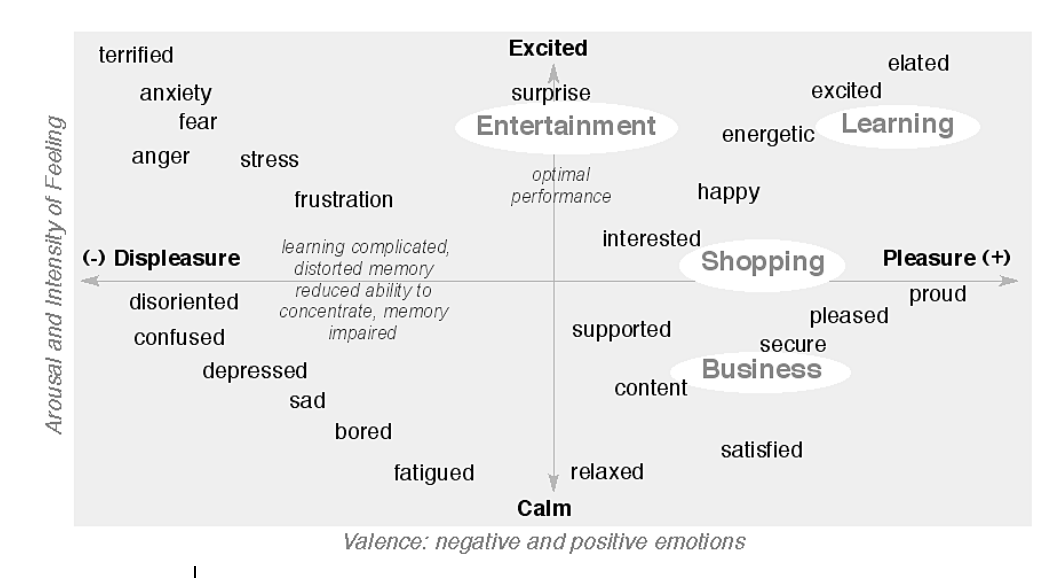
Parents need tools to help with negotiation, conflict management, and emotion management. Research shows that memory is distorted with high arousal levels and negative valence (fear, anxiety, stress, frustration).  Each repeated strike of emotion causes the perceived intensity to increase.

Mapping the Ecosystem

Mapping the ecosystem uncovers the dynamics of how an entity delivers its services and customer experience. Ecosystem mapping gives a greater understanding of the interdependencies and previously hidden processes, procedures, and root causes of problems. It allows for better communication across silos. 

In service design, stakeholders, the customer journey, touch points on that journey such as interactions online and offline, and each interaction are examined.  Each touch point is then designed to be intuitive, clear and easy to navigate.  The process is redesigned as needed and the pain points and best practices are noted. 

Giving Parents the View That They Need

A school cannot provide FAPE unless parents have a transparent view of the information, processes, and timelines involved in providing services and unless the school is accountable for implementation. Service design allows for transparency into the process. Design thinking and strategy allow for rethinking how we provide education by focusing on the unique needs of the customers. 

What Can We Do?

Pink Frog Interactive is a boutique design agency that provides service design and customer experience design for public services. We make complex processes and information clear. We partner with you to design products and services that are intuitive, save time and money, and foster trust.

At Pink Frog, our mission is to create a better world by doing human-centered design, making the complex clear, and solving complex problems with design thinking. Understanding people’s unique challenges, emotions, culture, and goals allow for empathy. Empathy creates compassion which is necessary for shifts in mindset. Shifts in mindset change the world. Our vision is a country where people have equal access to public services and information because they are designed in a way that is thoughtful, intuitive, easy to navigate, transparent, accountable and user-centered.  

People seek only the information that validates their existing beliefs which tends to make them believe it more whether right or wrong. 

Why you are kicking people off your social media page who don’t agree with you. 

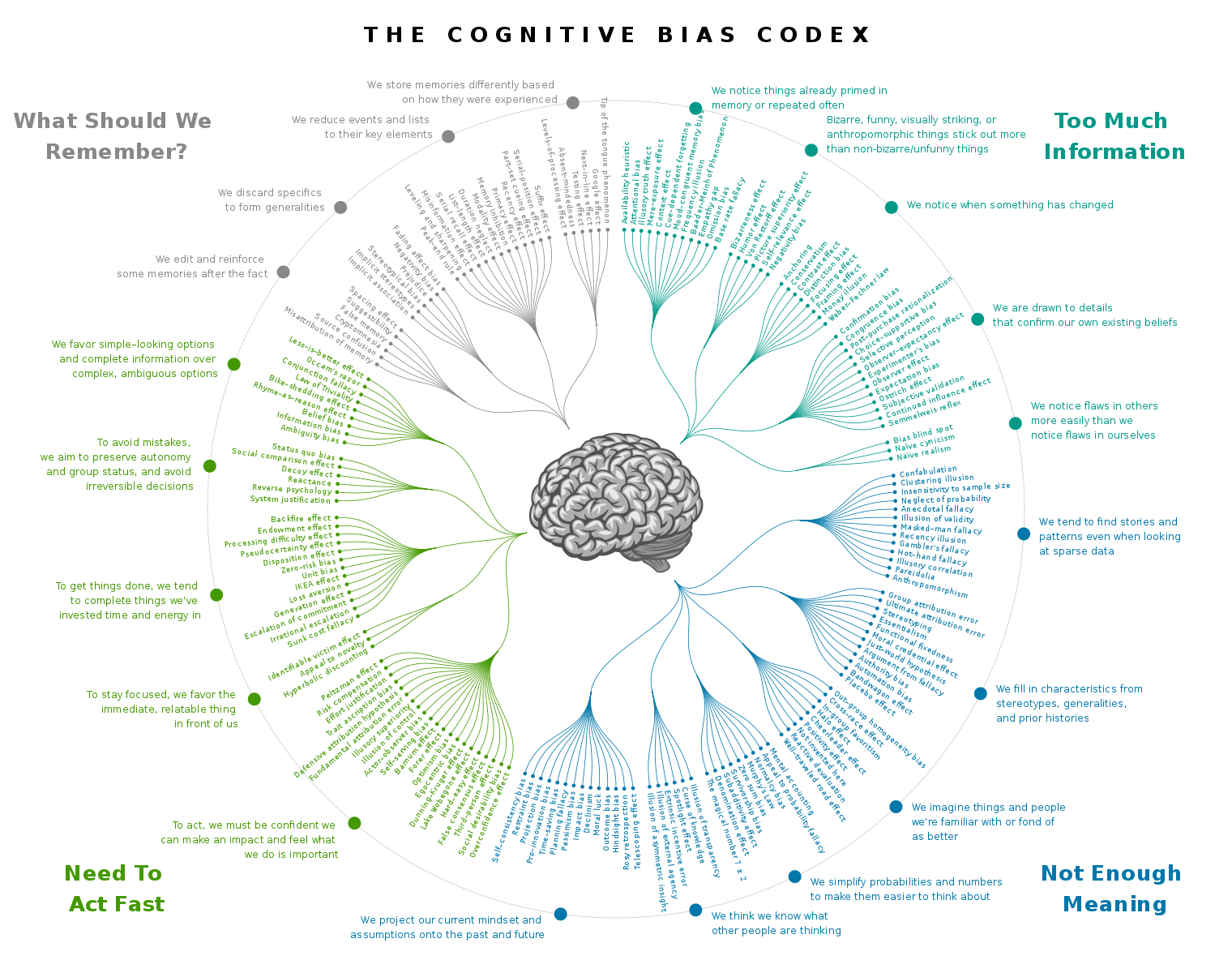
As a designer, I study people – the way they think, act,  perceive, learn, memorize, etc. Part of these human factors are cognitive biases. Confirmation bias is a type of cognitive bias that favors information that confirms previously existing beliefs or biases. 

People seek only the information that validates their existing beliefs which tends to make them believe it more whether right or wrong.  
Here are some ideas to avoid confirmation bias.  


Understand your tendency to exclude other opinions and facts and seek information that only validates your existing beliefs. Think For yourself. Do your own research. Question what you hear and see. Don’t just follow the crowd belief.Validate information with what you personally hear and observe. Sincerely listen to an opposing view without feeling your ego is being attacked and defending your stance. Seek information outside your normal comfort zone. Check all facts before jumping to conclusions. Challenge assumptions. Don’t read this and assume it doesn’t apply to you.

What are the least effective ways to eliminate confirmation bias?

Kick everyone off your social media page that doesn’t support your view. Name call and attack people with different points of view.Demean or stop talking to others that don’t agree with you. Surround yourself only with information and people that confirm your beliefs. Profile people into wide groups with sweeping generalizations – if you believe this then you also do x, y and z.


What ways can the government help with confirmation bias in government services?

Verifiable Data

Transparency

Accountability


Empathy – Understanding people’s unique challenges, emotions, culture, and goals allow for empathy. Empathy creates compassion which is necessary for shifts in mindset. Shifts in mindset change the world.

In the end, we will remember most the actions, character and behaviors of our family, friends and neighbors and the character traits they exhibited during this unprecedented time.

Our vision is a country where people have equal access to public services because they are designed in a way that is thoughtful, intuitive, easy to navigate, transparent, accountable and user-centered. 

Why we chose the name Pink Frog Interactive.

Pink

Pink is the color of happiness. Pink Frog brings joy to our clients and their customers. Joy is evoked in design with micro-interactions and an understanding of your users. Repeated strikes of an emotion cause it’s perceived intensity to increase. Happiness turns into joy after repeated positive interactions. Users remember the peak and endpoint of any experience. We focus on understanding your users’ emotions and finding out what constitutes exceptional customer experience. Happy users are more trusting and loyal.

Frog

Frogs are symbols of joy, luck, money, prosperity, abundance, wealth, and friendship in many cultures. Used as an amulet and talisman, they are strongly linked with transformation and magic and are believed to bring good luck. They are the magic in fairy tales and the secret ingredient in magic spells. The three-legged money frog, wealth frog, and lucky frog are three of the five Chinese gods that offer protection against misfortune and enrich a business or household in wealth. According to ancient Feng Shui beliefs, placing a frog near you dispels evil and attracts wealth.

Frogs are the happily ever after in fairy tales. If you kiss a frog, it turns into a prince. Frogs are the only animal that can only move forward and not backward. They can see in all directions without moving their head. A frog is often the elixir in magic potion.

Interactive

Interactive because we improve interactions at each touchpoint in your customers’ journey. We help you leap over your competition. We interact with you, your customers and your stakeholders to help you:

  • Tame complexity of your products or services.
  • Deliver innovative products and services that your customers love.
  • Decrease customer support calls.
  • Communicate complex information.
  • Help your customers intuitively navigate your product and services.
  • Help you understand how your customers learn and make decisions.
  • Help you understand how your customers define what constitutes an exceptional customer service.
  • Raise customer satisfaction scores.
  • Raise net promoter scores.
  • Gain more trust and loyalty from your customers.
  • Raise stock prices – companies that invest in design outperform 2 to 1. The key differentiator in companies is a positive customer experience. Customers choice products and services that are easy and joyful to use.

Behold! The power of design.

Pink Frog Interactive makes the list! 41 Most Innovative Product Research Startups & Companies.

Data Magazine showcased their top picks for the best Pennsylvania based Product Research companies. “These startups and companies are taking a variety of approaches to innovating the Product Research industry, but are all exceptional companies well worth a follow.

We tried to pick companies across the size spectrum from cutting edge startups to established brands.

We selected these startups and companies for exceptional performance in one of these categories:

Innovation
– Innovative ideas
– Innovative route to market
– Innovative product
Growth
– Exceptional growth
– Exceptional growth strategy
Management
Societal impact”

Pink Frog Interactive was listed as one of the 41 Most Innovative Product Research Startups & Companies.

source: https://datamagazine.co.uk/41-most-innovative-product-research-startups-companies-pennsylvania/

Why you are kicking people off your social media page who don’t agree with you. 

People seek only the information that validates their existing beliefs which tends to make them believe it more whether right or wrong. 

As a designer, I study people – the way they think, act,  perceive, learn, memorize, etc. Part of these human factors are cognitive biases. Confirmation bias is a type of cognitive bias that favors information that confirms previously existing beliefs or biases. 

People seek only the information that validates their existing beliefs which tends to make them believe it more whether right or wrong.  
Here are some ideas to avoid confirmation bias.  


Understand your tendency to exclude other opinions and facts and seek information that only validates your existing beliefs. Think For yourself. Do your own research. Question what you hear and see. Don’t just follow the crowd belief.Validate information with what you personally hear and observe. Sincerely listen to an opposing view without feeling your ego is being attacked and defending your stance. Seek information outside your normal comfort zone. Check all facts before jumping to conclusions. Challenge assumptions. Don’t read this and assume it doesn’t apply to you.

What are the least effective ways to eliminate confirmation bias?

Kick everyone off your social media page that doesn’t support your view. Name call and attack people with different points of view.Demean or stop talking to others that don’t agree with you. Surround yourself only with information and people that confirm your beliefs. Profile people into wide groups with sweeping generalizations – if you believe this then you also do x, y and z.


What ways can the government help with confirmation bias in government services?

Verifiable Data

Transparency

Accountability


Empathy – Understanding people’s unique challenges, emotions, culture, and goals allow for empathy. Empathy creates compassion which is necessary for shifts in mindset. Shifts in mindset change the world.

In the end, we will remember most the actions, character and behaviors of our family, friends and neighbors and the character traits they exhibited during this unprecedented time.

Our vision is a country where people have equal access to public services because they are designed in a way that is thoughtful, intuitive, easy to navigate, transparent, accountable and user-centered. 

The Top UX “Sins” Made by Beginner Designers.

  • Taking every bit of customer feedback and implementing it. 
  • Design by committee.
  • Listening to only what users say, not observing what they actually do. 
  • Not starting with a problem statement or reframing the problem. 
  • Going with the first decent idea.
  • Not understanding human factors – the way people think, make decisions, behave, perceive, cognitive biases, etc. 
  • Not using a hierarchy of information. 
  • Not asking the right questions.
  • Not talking to the right users. 
  • Not talking to any users. 
  • Leading users in design research with your own agenda.
  • Being biased.
  • Letting the stakeholders vote on the design (design by committee).

How to Communicate With Your Customers During Times of Crisis

Emotions are important in design because they are a powerful motivator and can influence perception, cognition, attention, decision-making, learning, memory and behavior. If we can learn how to evoke, predict or assess a specific emotion in design, we can better present information in a way that aids in understanding and retaining information and communicate more effectively.

Extreme states of emotions such as anxiety, fear and anger can complicate learning because they interfere with sensory perception.  Sensory systems allow us to make sense of ourselves and our surroundings and if distorted can cause the emotional organization of our experience to be compromised.  As a result, learning can be detrimentally affected. Under stress users can develop tunnel vision and auditory exclusion. For example, they wouldn’t hear an alarm going on while trying to complete a task.

When a person is highly aroused, as in a very shocking or surprising situation, they are more likely to form a memory of the event and possibly a distorted memory.  Arousal (excited/calm) has been found to be a better predictor of memory retention than valence (pleasure/displeasure).  However, strongly negative things tend to automatically be highly arousing, leading many to think that better memory is correlated with negativity.  If we are depressed, anxious or tired, we are more likely to have difficulty remembering.  When we are upset or distracted, we cannot concentrate as well which impairs our memory. Too much stress results in poor performance. 

To help communicate with your customers during periods of stress, fear, or anxiety several design principles are critical. 

Use bite-size chunks of information

Users can only consciously process small amounts of information at a time. Grouping and chunking information aids in memory retention.

Consistency and standards
Users should not have to wonder whether different words, situations, or actions mean the same thing. Be consistent. 

Error prevention

 Even better than good error messages is a careful design which prevents a problem from occurring in the first place.

Recognition rather than recall

 Make objects, actions, and options visible. The user should not have to remember information from one part of the dialogue to another. Instructions for use of the system should be visible or easily retrievable whenever appropriate.

Aesthetic and Minimalist Design

 Dialogues should not contain information which is irrelevant or rarely needed. Every extra unit of information in a dialogue competes with the relevant units of information and diminishes their relative visibility. 

Anticipation

 Anticipate the user’s wants and needs. Bring to the user all the information and tools needed for each step of the process.

Inconsistency
It is just important to be visually inconsistent when things must act differently as it when things act the same.

Good design is design thinking made invisible. Now more than ever, it’s important to understand and empathize with your customers, make doing business with you easy and intuitive, and provide clear communication.

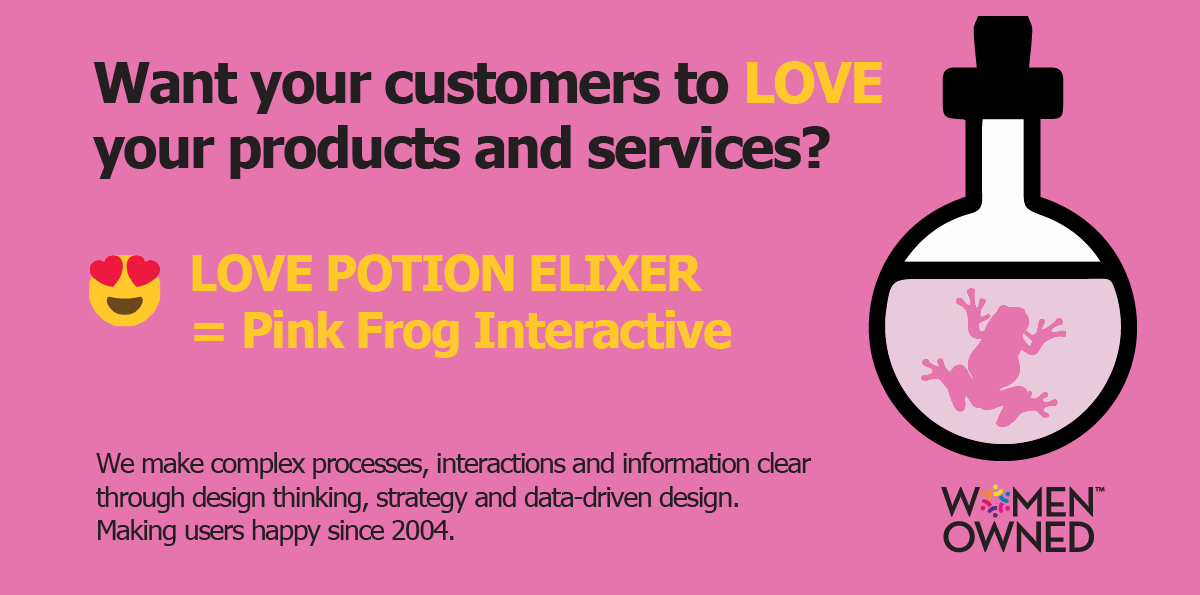
Partner with a frog, cast a love spell on your customers, leap over your competition and live happily ever after.

Frogs are symbols of joy, luck, money, prosperity, abundance, wealth, and friendship in many cultures. Used as an amulet and talisman, they are strongly linked with transformation and magic and are believed to bring good luck. They are the magic in fairy tales and the secret ingredient in magic spells.

Why we chose the name Pink Frog Interactive.

Pink

Pink is the color of happiness. Pink Frog brings joy to our clients and their customers. Joy is evoked in design with micro-interactions and an understanding of your users. Repeated strikes of an emotion cause it’s perceived intensity to increase. Happiness turns into joy after repeated positive interactions. Users remember the peak and endpoint of any experience. We focus on understanding your users’ emotions and finding out what constitutes exceptional customer experience. Happy users are more trusting and loyal.

Frog

Frogs are symbols of joy, luck, money, prosperity, abundance, wealth, and friendship in many cultures. Used as an amulet and talisman, they are strongly linked with transformation and magic and are believed to bring good luck. They are the magic in fairy tales and the secret ingredient in magic spells. The three-legged money frog, wealth frog, and lucky frog are three of the five Chinese gods that offer protection against misfortune and enrich a business or household in wealth. According to ancient Feng Shui beliefs, placing a frog near you dispels evil and attracts wealth.

Frogs are the happily ever after in fairy tales. If you kiss a frog, it turns into a prince. Frogs are the only animal that can only move forward and not backward. They can see in all directions without moving their head. A frog is often the elixir in magic potion.

Interactive

Interactive because we improve interactions at each touchpoint in your customers’ journey. We help you leap over your competition. We interact with you, your customers and your stakeholders to help you:

  • Tame complexity of your products or services.
  • Deliver innovative products and services that your customers love.
  • Decrease customer support calls.
  • Communicate complex information.
  • Help your customers intuitively navigate your product and services.
  • Help you understand how your customers learn and make decisions.
  • Help you understand how your customers define what constitutes an exceptional customer service.
  • Raise customer satisfaction scores.
  • Raise net promoter scores.
  • Gain more trust and loyalty from your customers.
  • Raise stock prices – companies that invest in design outperform 2 to 1. The key differentiator in companies is a positive customer experience. Customers choice products and services that are easy and joyful to use.

Behold! The power of design.